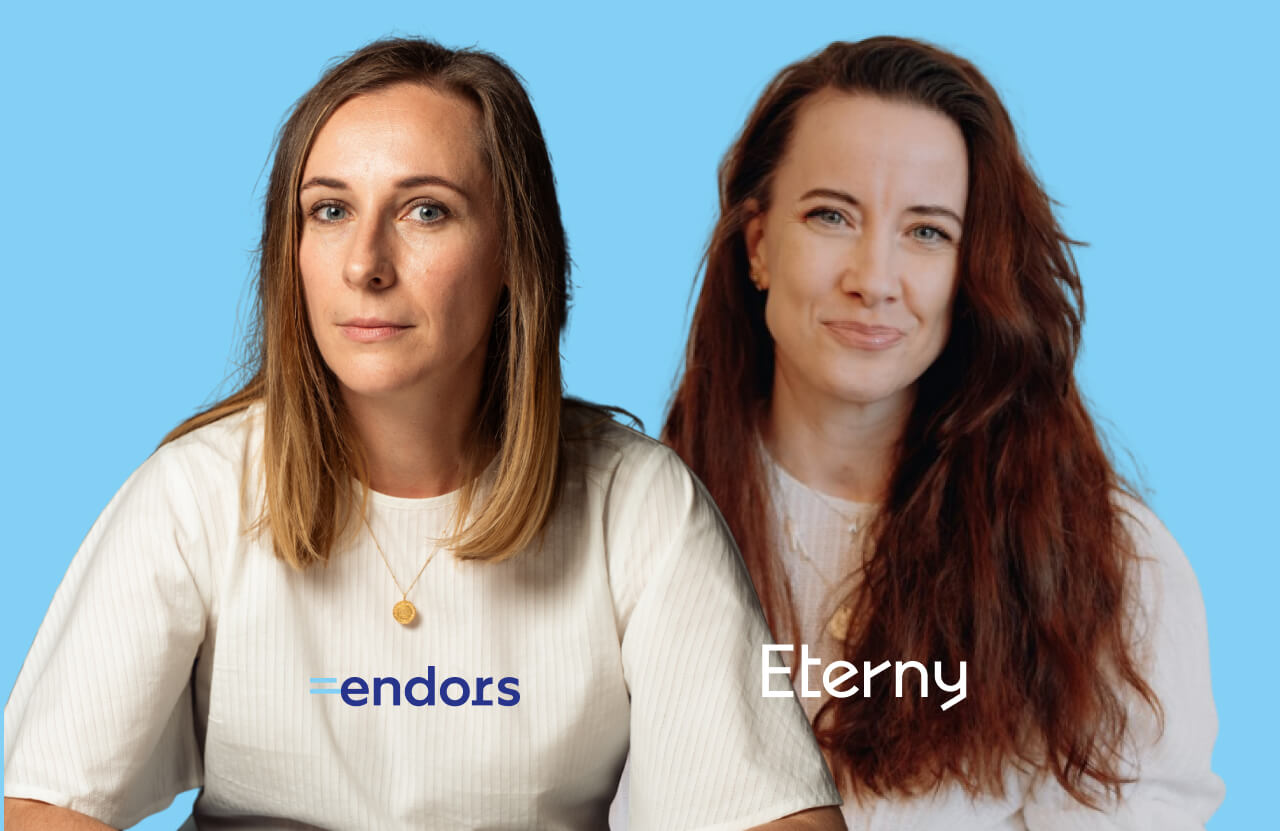
The best thing you can do is prepare even for what we hope will never happen. And that is how the partnership between the endors law firm and the Eterny platform came about. Kateřina Obertová, our expert in family and inheritance law, and Jitka Paterová, founder and CEO of the Eterny platform, which focuses on wealth management and passing assets on between generations, reveal the ways in which you can leave your assets to your loved ones.
When planning your children’s future, you need to distinguish between two basic scenarios, because the solution is different in each case.
When something happens to only one of the parents, you mainly deal with the property consequences – especially when someone depends on you for support or other needs.
“Although it is difficult, you need to think about what would happen if you could not make payments as you are used to, or manage assets in a particular way. What impact would that have on the children or on your partner,” says Kateřina Obertová, an attorney at endors.
This is a very demanding and difficult situation both emotionally and legally, because parental responsibility passes to an entirely different person. That is also why it is good to reflect on the following questions:
The law allows parents to express in their will their wish as to who should become the guardian of their children in the event of their death.
Typically, grandparents are the most common choice, if they are in good health. Other options are siblings, if they are already adults and settled, or close friends or a godparent – essentially anyone you trust and who has a genuine relationship with your children.
The court may also appoint two persons as guardians. As a rule, they will be a married couple. Until the court appoints a guardian for the child, the child’s interests are protected by a court-appointed curator – usually the child welfare authority (OSPOD), which represents the child until the guardianship is decided.
In your will, you can specify not only who should be the guardian, but also the type of upbringing and education you wish for your children. You can express the values you want to preserve and the way of life you want to provide for your children. “It is perfectly possible to set out how the children should be educated and raised in this way as well,” adds Kateřina.
Read our article on how to write a will – https://www.endors.cz/blog/jak-napsat-zavet
When children inherit assets from their parents, they cannot freely dispose of them, because they are minors and do not have full legal capacity. In such a case, a curator (opatrovník) steps in.
A curator is a person who represents a minor child in legal acts, manages the child’s assets, makes decisions in property matters and submits regular reports on the management of the assets.
If the decision is a relatively significant one, such as selling a house or a larger financial transaction, court approval is also required. It is necessary to explain the situation to the court, what needs to be done, justify it and then wait to see whether the court grants approval, and only then can the specific transaction be carried out.
Many people are wary of trust funds, but in family law they are an invaluable tool. A trust fund makes it possible to set assets aside so that the children benefit from them.
A trust fund is not a conventional legal entity, but a defined pool of assets with precise rules for its management.
“These are mechanisms that allow part of the assets, or even all of them, to be set aside, and determine how an independent person will deal with them so that specific persons – typically children – benefit from them,” explains Kateřina.
“In today’s Czech conditions, a trust fund really tends to be a complement to a will rather than the only arrangement for one’s assets in case something happens. It is typically used when someone manages a family holding that comprises a number of companies, property and other assets, and there is an interest in having that family holding continue in a certain direction and the assets continue to be managed in a certain way,” adds Kateřina.
If you have named a guardian in your will, the court usually respects your choice, unless it is contrary to the children’s interests. Without a will, the court decides, usually in favor of the grandparents or closest relatives. The court always examines what is in the child’s best interests.
Yes, you can express your wishes regarding upbringing, education, religious faith or values. However, these wishes are not absolutely binding. If they were contrary to the children’s interests or if circumstances changed significantly, the court may decide otherwise. With children, their legitimate interest is always examined, and it usually outweighs the parents’ wishes.
The children’s assets are managed by a curator, usually the same person as the guardian. The curator decides ordinary matters alone, but needs court approval for larger financial operations such as selling real estate or larger transactions. The curator must submit regular reports on how the assets are being managed, so there is a certain degree of oversight.
A trust fund is a defined pool of assets with rules for its management. It is suitable for families with significant assets, a family business or more complex asset structures, for example when someone manages a family holding that comprises a number of companies, property and other assets. It allows long-term protection of assets and their gradual transfer to the children according to your rules.
Yes. Anyone you trust can be a guardian, including someone outside the family. It can be a close friend or a godparent. What matters is that it is a person who has a genuine relationship with the children and is able and willing to take care of them.
Create a well-organized folder, physical or digital, containing contacts for doctors, information about school and extracurricular activities, allergies and health restrictions, the children’s hobbies and interests, and important documents such as birth certificates, passports or vaccination records. Platforms like Eterny allow you to store everything digitally with access for a trusted person.
“At that moment, what matters is how the child feels in such a situation, not who ultimately gets the assets,” Kateřina Obertová reminds us of the fundamental principle that should guide all parents when planning their children’s future.
Let us hope that cases in which children lose both parents are truly minimal and close to zero. Still, it holds true that responsible parents think about it in advance. Because being prepared is not about fear of the future – it is about protecting those we love most and ensuring stability, love and care even in the hardest moments.
You don’t have to solve everything at once. Start with these three steps:
1. Write down your answers on paper
Who should take care of your children? What values are important to you? What should the children know about your wishes? It is not a legal document – it is the basis for a conversation.
2. Talk to the person you have chosen
Ask whether they would be willing to be the guardian. Explain your ideas about upbringing. Make sure they understand your values.
3. Take stock of your assets
A list of accounts, investments, insurance policies, real estate. It doesn’t have to be perfect – a basic overview is enough to start. Platforms like Eterny can help you with this.
After these steps, you will be ready for a consultation with a lawyer and, if appropriate, for drawing up a will.
Active wealth management and its legal protection are an investment in your family’s peace of mind and stability. Don’t put off finding a solution until it is too late.
Your documents and assets under control. For you and your family. Forever. All your finances, investments and important documents in one place. Secure, organized, optimized and always at hand.
Prevention is not about fear of the future, but about protecting what you have today. The best thing you can do for yourself and your loved ones is to prepare even for what none of us wants to think about.
Complicated inheritance of assets or difficult divorces – situations in which emotions mix with law and money tend to be challenging. We know from practice that we can prevent most complications – prevention is key, and it is above all about protecting what you have today.
Your story deserves attention.
Treat yourself to a lawyer who will give it that attention, and get in touch with us – info@endors.cz
Often the best thing you can do for yourself and your loved ones is to prepare even for what we hope will never come. Part of such preparation is also education, through which you can find out what your options are. And that is how the partnership between the endors law firm and the Eterny platform came about.


Your story deserves attention.
Treat yourself to a lawyer who will give it that attention, and get in touch with us – info@endors.cz