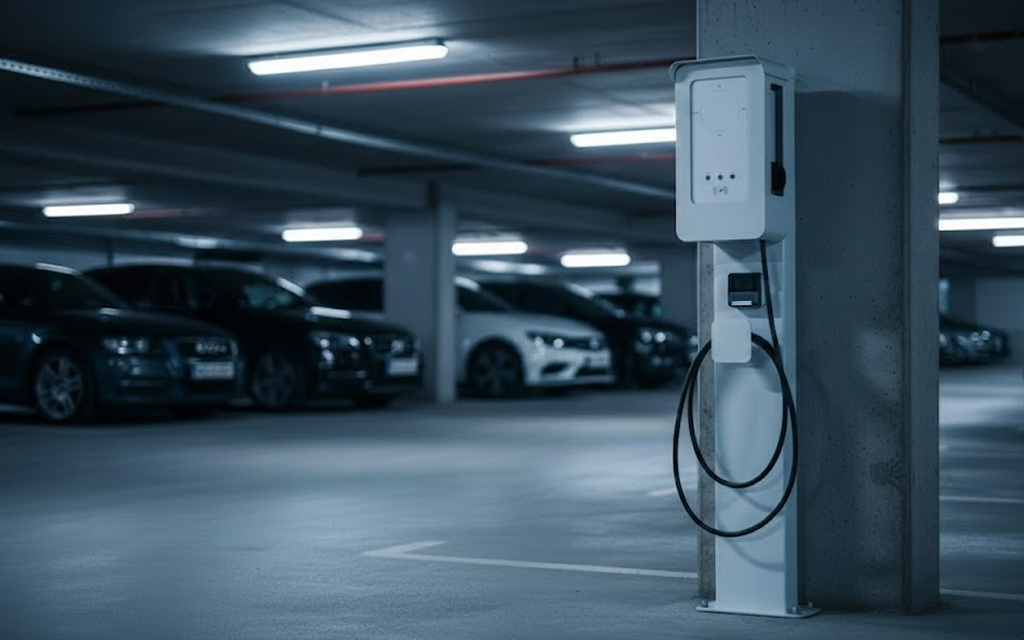
In a single-family house, the situation is simple – you own both the land and the building, you install the charging station in your own garage on your own land, and you power it from your own electricity meter. With few exceptions, there is nothing to think about here, and you can have a home wallbox installed without further ado.
You can do the same if you want to install a wallbox in an apartment building with separate garages that you own, provided you do not need to interfere with the building’s electrical wiring and you have a sub-meter that measures your own consumption.
Similarly, there is nothing to resolve in new buildings, where parking spaces are already prepared for wallbox installation, as the building design usually also provides for a method of reading electricity consumption.
In an apartment building, however, you will run into the concept of so-called common ownership. An EV charging station almost always affects the common parts of the building:
And this is where the legal issues begin: under the law, changes that would burden the other co-owners or restrict their rights cannot be made without their consent.
In the vast majority of cases, you will need the consent of the other unit owners. However, you have no legal entitlement to it, so it is advisable to find out in advance whether your neighbors are open to changes in the common parts of the building.
Let’s start with the most important point: a unit owner has no statutory entitlement to place a wallbox in the common parts of the building. Under the Civil Code and the Unit Ownership Act, any changes to the common parts of the building require the consent of the co-owners. And in most cases, a wallbox is such a change – you are adding a device that consumes energy, takes up space, and may affect the other owners.
In practice, this means: you will need consents. And the other unit owners are not obliged to give them to you.
The good news is that most homeowners’ associations today understand the reality of electromobility, and if you present them with a well-prepared proposal that clearly addresses costs and responsibilities, consents are usually not a problem. At endors, we have prepared and managed many of these approval processes for our clients.
In 2023, the Ministry of Regional Development, the Ministry of Industry and Trade, and the Ministry of Transport issued a methodology for installing wallboxes in the common areas of apartment buildings. In practice, it can serve as a guide for both homeowners’ associations and unit owners.
The methodology distinguishes three basic situations that clearly define which consents or steps we will need to obtain.
Typically, this involves installation on the wall next to your parking space, which is marked only by lines or markings on the floor. You do not own it exclusively; you only have the right of exclusive use under the owners’ declaration or a decision of the SVJ.
Legally, this is the most complicated option – the wallbox affects the common parts, connects to the shared wiring and, if you do not have your own meter, you consume shared electricity.
You have your own garage space registered as a separate unit in the Land Registry. In this case, the situation is simpler – you install the wallbox in your own property, often already with your own meter.
In most cases, however, you still need consent to the installation (because the cabling may run through common areas), but you no longer need to amend the owners’ declaration regarding costs.
The wallbox is located outdoors on the land of the apartment building, next to a parking space designated for your exclusive use. From a legal standpoint, the situation is similar to option 1, but there may also be a requirement for a building permit (if a free-standing post needs to be built).
Essentially the same rules regarding consents and amending the declaration apply to all three situations. They differ mainly in the technical details, which we will go through together.

Let’s start with the most demanding process ahead of you – collecting signatures from the co-owners in the apartment building:
The owners’ declaration typically contains a provision stating that the costs of the common parts of the building are borne by all owners in proportion to their co-ownership shares. If you installed a wallbox without amending the declaration, the other owners would have to share in the costs of operating your wallbox.
And that would be unlawful – they cannot pay for something they cannot use. Moreover, a wallbox consumes a considerable amount of electricity (typically 11–22 kW of output), i.e., significantly more than ordinary household appliances.
Which consents do you need?
To amend the owners’ declaration, you need:
A “directly affected owner” is one whose rights would be immediately restricted by the change. In practice, this rarely occurs with wallboxes – directly affected owners would be, for example, neighbors whose parking space the installation would restrict in some way.
When do you not need to amend the declaration?
There is a legal exception: if you have your own sub-meter for the wallbox or a separate contract with an energy supplier.
In that case, the other owners do not share in the costs of operating the wallbox – you pay for it entirely yourself. Therefore, there is no need to amend the declaration with respect to cost allocation.
This exception most often applies when you have your own garage registered as a separate unit with its own meter.
Note: Even with a sub-meter, however, you will still usually need consent to the installation (see point 2).
Even if you do not need to amend the owners’ declaration (see above), in most cases you will still need consent to install the wallbox in the first place.
Consent is required from more than half of the owners.
When do you not need it? Only if the installation of the wallbox does not require any interference with the common parts of the building – i.e., not even the additional installation of electrical and data wiring.
In practice, this only applies when you already have your own garage with the wiring in place. Such cases are rare, however.
Here you need to distinguish between installing a wallbox inside the building and outside – they are treated differently.
If you install a wallbox inside an apartment building, you usually do not need a building permit.
The reason is simple: the installation of electrical and data wiring itself is not considered a structure or a construction modification. A wallbox is a technical device attached to a wall – essentially, it is an installation, not construction.
You would only need a building permit if more extensive construction work on the garage were involved – for example, demolishing walls, structural changes, etc. In practice, however, this virtually never happens with wallboxes.
Here the situation is more complicated. If you install the wallbox as a free-standing charging post that is firmly anchored to the ground and connected to an electrical line, it is considered a structure under the Building Act. And a structure requires a building permit.
The solution: If you have a choice, install the wallbox on the exterior wall of the apartment building rather than as a free-standing post. A wallbox mounted on the facade is not considered a structure, so you will avoid lengthy administrative proceedings.

Even once you have all the consents, you are not quite at the finish line. You must meet further requirements:
For a standard AC wallbox with an output of up to 22 kW, you must ensure the proper technical equipment – Type 2 sockets with one pin and two sleeves, appropriate circuit protection, and short-circuit protection.
In practice, this means the wallbox must be installed by a specialized company with the relevant qualifications. A do-it-yourself “off-the-books” solution is not only dangerous but also illegal.
Fire regulations do not require any special modifications for a wallbox. However, we recommend:
These requirements also follow from insurance terms and conditions – in the event of a fire caused by improper installation, you may have problems with your insurance payout.
Regular inspection of the wallbox is required by law, as with all electrical equipment. If you fail to arrange an inspection, you are breaking the law, and in the event of damage, it will significantly affect your insurance payout.
The last but crucial step: you must apply to the electricity distributor to connect the wallbox to the distribution grid. Or, if necessary, for an increase in the reserved capacity if the existing connection is insufficient. You cannot legally operate the wallbox without the distributor’s consent. In practice, distributors usually approve such applications, but the process may take a while.
Note: If you connect a wallbox without the distributor’s consent, you risk being disconnected from the grid and fined.

So that nothing slips through the cracks, here is a clear procedure from the lawyers at endors covering everything you need to do:
First, inform the other unit owners of your intention to install a wallbox. At the same time, propose an amendment to the owners’ declaration and request consent to the installation (if these steps are necessary in your case). The amendment to the declaration must be approved by more than half of the owners, plus all directly affected owners.
If you needed an amendment to the declaration and obtained consent, file an application for registration in the Land Registry. You can file either an amendment to the existing declaration or a proposal for a new consolidated version.
If you are installing the wallbox as a free-standing post outdoors, obtain a zoning decision or consent from the building authority. However, this applies only to a minority of cases.
Obtain project documentation for the wallbox installation. Check that everything complies with the technical requirements and fire regulations. And don’t forget to notify the SVJ committee of the planned installation – even if you do not need any consents.
Only once all these conditions have been met can you proceed with the physical installation of the wallbox.
In practice, we find that homeowners’ associations often reject wallboxes. Not out of ill will, but because of concerns and uncertainty. We have prepared an overview of the most common questions homeowners’ associations ask, along with answers that can help dispel their concerns.
Homeowners’ associations often reject a wallbox, saying that you first need to bring an assessment from the Fire Rescue Service. Sometimes they even demand a special “fire safety report” or “Fire Rescue Service consent to charging electric vehicles.”
Legal analysis: If you are not changing how the space is used, no new fire safety assessment is needed. The garage was approved for occupancy as a garage for motor vehicles – and this applies equally to cars with combustion engines and to electric vehicles. Under current legislation, electric vehicles are subject to the same fire safety regime as ordinary cars, so no new statement is required.
A common concern of SVJ committees is that the building will have to invest in a special fire suppression system because of electric vehicles.
Legal analysis: You don’t have to. Current legislation does not require apartment buildings to install special fire suppression systems because of electric vehicles. If the SVJ wants to increase fire protection as a precaution, that is commendable – but it is not a condition for approving a wallbox.
The SVJ is concerned that installing a wallbox will cost the common parts of the building something, or that any repairs will be paid from the repair fund.
Legal analysis: All costs associated with the wallbox are paid by the person who wants it. The wallbox installation, the cabling, the sub-meter, the inspections – everything is at the applicant’s expense. That is also why the applicant proposes an amendment to the owners’ declaration that clearly states that the costs of operating the wallbox are borne by that person.
If anything needs to be repaired or modified in the future, those costs will again be borne by the wallbox user. It won’t cost the SVJ a single koruna.
If you encounter resistance from the SVJ, we recommend not reacting emotionally – the SVJ has a legitimate right to ask questions and bears responsibility for the safety of the building. If you can, ask for a personal meeting, because an email or letter is easy to ignore, while a personal meeting with the committee is much more effective.
Offer to attend a committee meeting and explain everything. Prepare documentation and information about the wallbox in advance, along with the draft amendment to the declaration, the installation company’s contact details, and fire safety information.
And if there are neighbors in your building who are also planning to get an electric car, or people who will support you, bring them together – when more people speak up at the SVJ meeting, it carries more weight.
At endors, we help clients with this entire process – from a legal analysis of the specific situation and the preparation of documentation to communication with the SVJ and management of the approval process. We see where mistakes are made and know how to prevent them. We also know the arguments homeowners’ associations use most often and can prepare factual responses to them.
Because a wallbox is not just a technical matter – it is above all a legal project and a communication challenge.
Contact us at info@endors.cz or call +420 222 767 393
Ondřej Chlada is a partner and head of employment law at endors. He specializes in advising both Czech and international clients. He helps companies strategically manage employment relationships and set up modern HR processes. He is a leading expert in employment law in the Czech Republic, recognized by international rankings – Chambers and Best Lawyers. He is also a keen enthusiast of modern technology.
Kilián Slovák started at endors as a legal assistant and now works as a Junior Associate. His work focuses primarily on drafting contracts in the areas of corporate and contract law and transactions, and he also handles administrative law matters.