The foundation is EU Directive 2023/970, which Brussels adopted in response to a simple fact — the gender pay gap in the EU has not improved significantly over the last ten years. In the Czech Republic, the situation is somewhat "worse," but we will get to that in a moment. So, what does the directive itself bring, and what does it require of us?
What matters is what the directive means for companies. These are extensive changes that will affect employers regardless of their size and will require adjustments to recruitment processes, communication, and internal salary structures.
The directive requires that, ideally before the interview, an applicant learns about the pay range for the position. Employers are then prohibited from asking about an applicant's previous salary and must ensure that job advertisements and job titles are gender-neutral.
Under the Pay Transparency Directive, applicants have the right to receive information about the starting pay or its range – either directly in the job advertisement, or no later than before the interview.
Another key requirement of the directive is the prohibition on inquiring about how much an applicant earned in their previous employment. Employers may not ask applicants about their salary history in relation to their current or previous employment relationships.
The goal is for the salary level to be determined based on the requirements of the given position and objective criteria – not based on the terms the candidate had with their previous employer.
For HR teams, this means adjusting questionnaires, recruitment forms, and the interviews themselves. The ban should also apply to any indirect questionsthat could reveal salary history.
For example, "what are your financial expectations relative to your previous position?" or "what was your last compensation including bonuses?".
The directive further establishes the obligation to ensure that job vacancy notices, job titles, and recruitment procedures are gender-neutral and non-discriminatory. The goal is to ensure that the recruitment process itself does not undermine the right to equal pay for equal work or work of equal value.
These rules have been part of the Czech legal system for some time and are even frequently subject to inspections by the Labor Inspectorate. Nevertheless, many employers forget this. When addressing the new rules, it is therefore appropriate to consider whether your processes comply in this respect as well and to adjust them if necessary.
The directive also requires that employees be able to request information from their employer about the average pay of colleagues performing work in the same category, broken down by gender. The employer must respond within a reasonable timeframe and in a format that does not allow for the identification of specific individuals (GDPR). And if they request a salary increase based on the data, the company must not take retaliatory measures.
The directive requires that employees have the right to request information from their employer regarding their own pay and, at the same time, information about the average pay of other employees performing the same work or work of equal value, broken down by gender.
The employer will be required to provide this information within a reasonable timeframe and in a format that allows for an assessment of whether there is a pay gap that cannot be objectively justified.
If an employee finds that their pay deviates from the average, they have the right to request an explanation of the objective criteria upon which the difference is based.
"An employer can base their justification on objective criteria such as qualifications, experience, complexity, difficulty, responsibility, or performance, or the actual amount of work performed," adds attorney Ondřej Chlada.
However, at the same time, when an employer provides information about the average pay of their employees, they must not forget about the GDPR (2016/679) regulation. This means that the data must be provided in a format that makes it impossible to directly or indirectly identify a specific employee.
In practice, this means that the employer will only provide aggregated or anonymized data — for example, the average or median pay of a group of employees categorized by objective criteria, not individual amounts assigned to specific persons.
"A common question we are encountering now is: how much information should I actually provide? The general answer is simple — never individual amounts for specific persons. Always as a group, always anonymized. The upcoming draft law will then provide us with specific boundaries and cases where providing information will not be possible," adds Ondřej Chlada.
Consequently, the employer is not required to provide a detailed breakdown of individual salary components for specific persons, internal evaluation materials, personnel files, performance review results, or any other documents that would allow for identifying specific employees.
If, based on the information provided, an employee claims they are being paid unequally, the Pay Transparency Directive introduces a shift in the burden of proof.
The employee must present facts suggesting unequal pay, and the employer must then prove that no inequality exists or that it is objectively justified.
"We already see this principle partially in court disputes today, where it is often up to the employer to refute an employee's claims of unfair pay and convince the court that they acted correctly. In practice, it is necessary to be very careful about what information and documentation you provide, and in the event of a threatened or ongoing dispute, it is always wise to consult with an attorney." comments attorney Ondřej Chlada.
In the event of a violation of the right to equal pay, the employee is entitled to salary arrears, compensation for lost earnings, damages, and potentially compensation for non-pecuniary damage.
"Salary arrears for three years back, compensation for lost earnings, and non-pecuniary damage — for a medium-sized company, we can quickly reach hundreds of thousands of crowns per employee. Prevention is a fraction of that cost. We recommend that clients conduct a compensation system audit and have clearly defined criteria. Get in touch with us, and we will review your situation together and determine what makes sense to resolve," concludes Ondřej Chlada.
The directive prohibits employers from disadvantaging employees in any way for requesting information about their pay, pointing out inequality, or seeking redress. This protection also extends to colleagues who assist them.
We can help with a compensation audit, drafting internal policies in line with the new directive, revising recruitment templates, and training your HR team. Write to Ondřej Chlad at info@endors.cz — we respond within 24 hours.
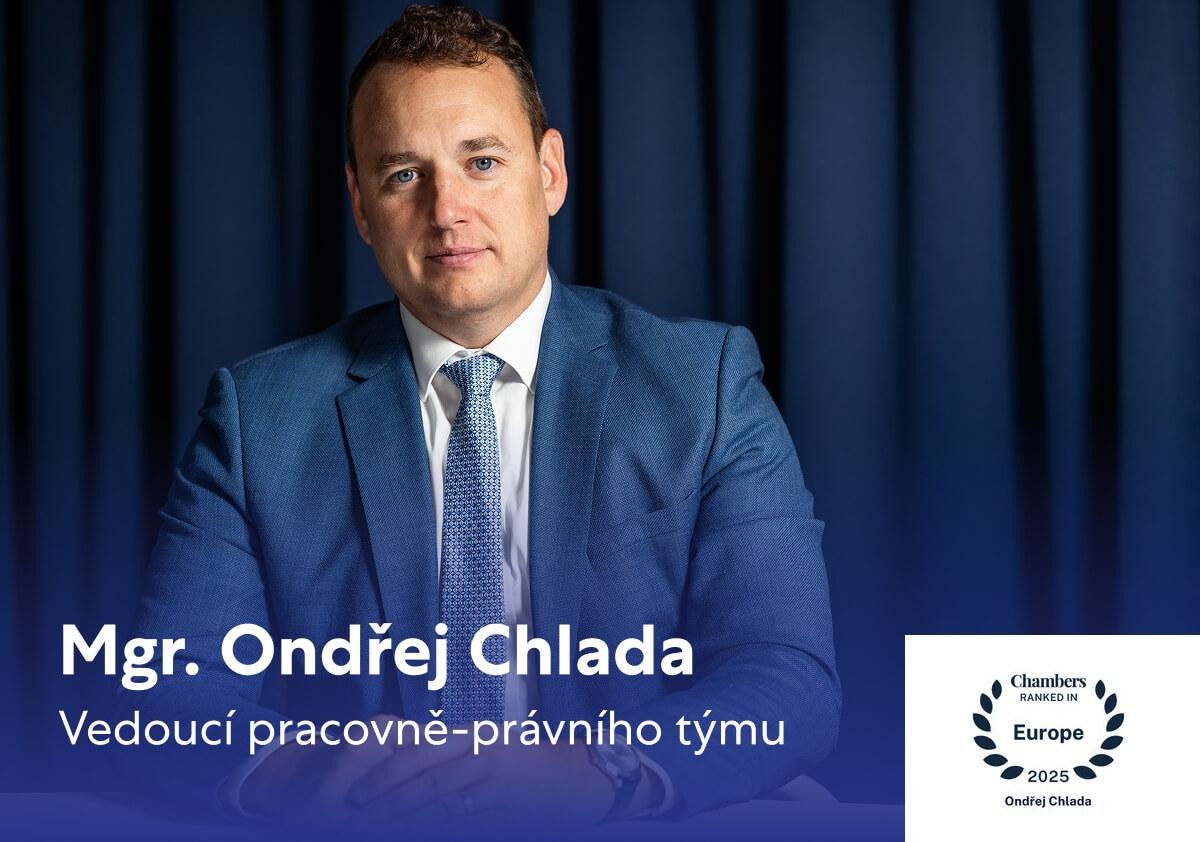
Ondřej Chlada joined endors in the autumn of 2025, when he took over the leadership of our employment law practice. With 15 years of experience he is among the highest-rated Czech lawyers in the field — Chambers Europe ranked him as a recommended lawyer in employment law in both 2024 and 2025, and he has been featured in the Best Lawyers rankings since 2018.
He manages complete corporate HR agendas: remuneration audits, preparation of internal regulations, collective bargaining, and employment disputes.
Employers may not restrict employees from discussing their salaries. Salary confidentiality clauses in employment contracts are illegal and their use can result in a fine of up to CZK 400,000 from the Labor Inspectorate.
Confidentiality clauses were common in employment contracts and agreements and were often drafted very broadly — they included not only the protection of confidential information but also a prohibition on disclosing one's own salary, bonuses, or other compensation terms. Employers used these to prevent discussions among employees and potential disputes over unequal pay.
Since last year, however, it has been the case that employers are prohibited from restricting employees from disclosing information regarding the amount and structure of their wages, salary, or remuneration under an agreement. This was one of the first tangible impacts of the directive on the Czech legal system.
This prohibition is specifically enshrined in Section 346a of the Labor Code – it was part of the so-called "flexi-amendment" to the Labor Code (Act No. 120/2025 Coll.).
Employees may disclose their remuneration to colleagues, unions, or anyone else without violating their employment contract.
The non-disclosure ban applies to all forms of remuneration—including agreements to perform work (DPP) and agreements to perform activity (DPČ). At the same time, this does not mean that employers are required to actively publish wages; it simply means that employers must not prevent employees from talking about their pay.
Violating this prohibition is an offense for which the Labor Inspectorate can impose a fine of up to CZK 400,000.
Ondřej Chlada will review your existing and past contracts and agreements to ensure they comply with current and upcoming regulations. We respond within 24 hours. Email us at info@endors.cz
It is important to emphasize, however, that the new regulation only concerns an employee's own wages. Employers may continue to restrict the disclosure of information regarding the wages of other employees—these are not subject to this right to share information.
The upcoming amendment to the Labor Code (and other laws), which aims to fully implement the principles of the directive into the Czech legal system, also brings, among other things, an expansion of this non-disclosure restriction. With the planned effective date of 2027, it will no longer be possible to restrict employees from sharing information not only regarding their wages but also in relation to other benefits provided to them in connection with the performance of work. Typically, this will include all employee benefits.
In a separate article, you can find out who is affected by gender pay gap reporting and what data you must process.
According to the draft transposition law, from January 1, 2027, the employer must inform the applicant of the minimum salary level no later than before the conclusion of the employment contract/agreement. The amendment does not explicitly mandate stating the salary directly in the advertisement.
Up to 400,000 CZK. The Labor Inspectorate can impose this fine for a violation of Section 346a of the Labor Code, which has been in effect since June 1, 2025, and prohibits employers from restricting employees from sharing information about their own pay. From January 1, 2027, this restriction is expected to be extended to other benefits as well.
Yes, but only in an aggregated form – the average or median salary of a group of employees broken down by gender. Employers are not required, and are not permitted (due to GDPR), to provide detailed breakdowns of individual salaries of specific persons.
Employers with 100 or more employees. Companies with 250+ employees will report every year, while companies with 100–249 employees will report once every three years. The reporting obligation will apply for the first time in 2028 for the year 2027 (for employers with 100–149 employees, the first report will not be due until 2031 for the year 2030).
A new section introduced by the amendment to the Labor Code starting in 2027. It mandates that employers create a remuneration system based on an objective classification of jobs into groups according to their value, derived from their complexity, responsibility, and physical or mental demands. In addition, employers will often need to prepare a system for providing other benefits.
A mechanism under Article 18 of the Directive. If an employee presents facts suggesting unequal pay, the employer must provethat no inequality exists or that it is objectively justified—the opposite of what is standard in civil disputes.
Didn't find the answer to your question? Ask Ondřej Chlada directly. We will respond within 24 hours.
Attorney Ondřej Chlada is a partner at endors and a leading expert in labor law. He is recognized in rankings Chambers Europe such as Best Lawyer, has over 15 years of experience, and has handled hundreds of labor law cases—representing both employers and employees.
→ Schedule a consultation with Ondřej. Or contact us directly: info@endors.cz | +420 601 501 630